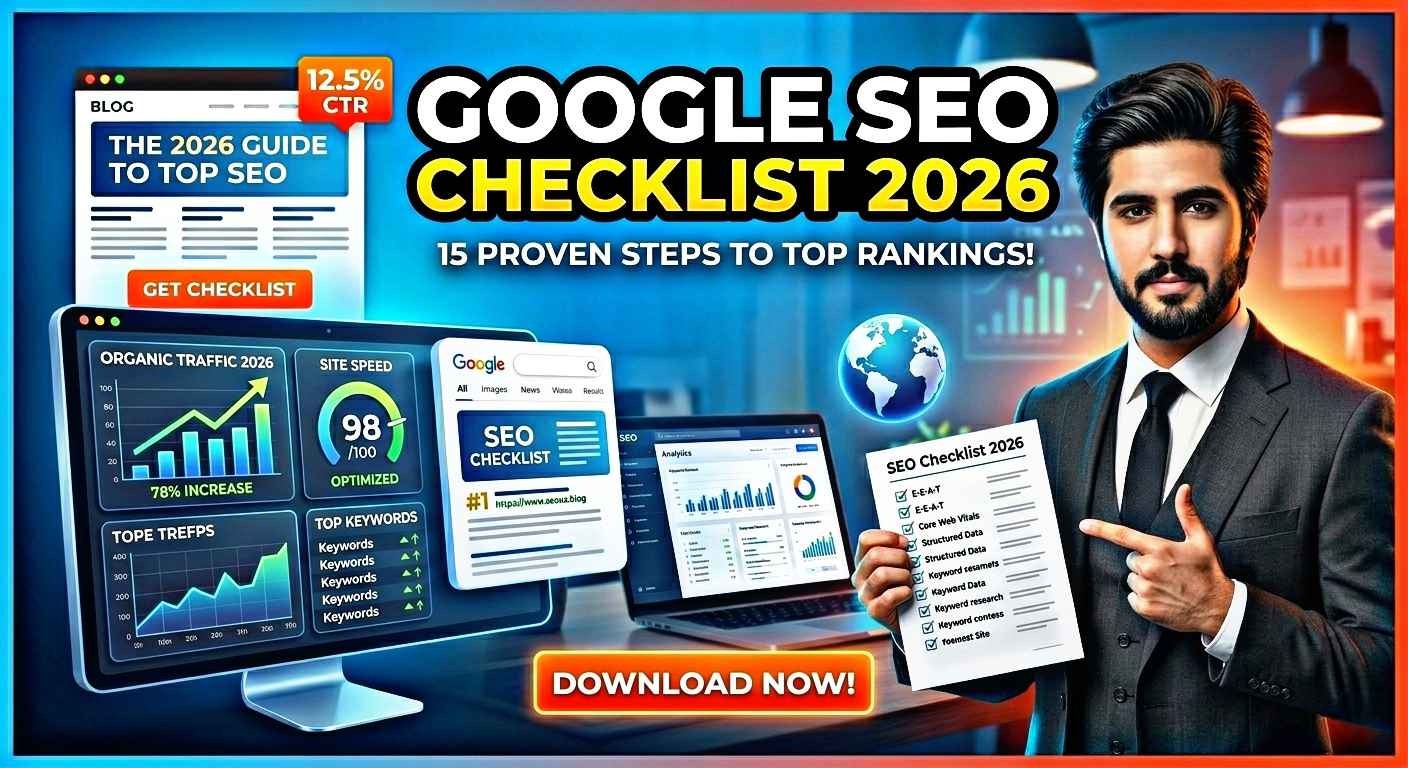
Getting a website ranked in 2026 isn’t just a matter of keywords. Google now places greater importance on user experience, helpful content, website speed, mobile optimization, and trust signals. Therefore, it’s essential for every blogger, business owner, freelancer, and content creator to follow a strong Google SEO checklist.
Many websites publish content these days, but only those that use proper SEO strategies rise to the top. If you want to increase your website’s organic traffic, improve Google search rankings, and achieve long-term online growth, this complete SEO checklist will be very useful.
In this guide, we’ll cover all the important SEO points that matter for Google ranking in 2026 in simple Roman Urdu.
Why This Feature/Technology Works Better in 2026
Google’s algorithm in 2026 has become smarter than ever before. The search engine no longer just looks at keywords, but also understands user intent. If a user needs a fast answer, a helpful guide, or reliable information, Google ranks pages that genuinely provide value.
Core Web Vitals have now become a crucial part of SEO. Fast-loading websites, mobile-friendly design, and a secure HTTPS connection have a strong impact on ranking. Voice search and AI-based search systems have also improved, causing natural language content to rank higher.
Topical authority is also very important in 2026. This means that if you consistently publish quality content in a niche, Google will begin to consider your website a trusted source. Therefore, a focused SEO strategy is more effective than random content.
How to Use Google SEO Checklist for Best Results
Step 1: Basic Setup or First Method
First, strengthen your website’s technical setup. The domain must be secure and HTTPS enabled. Use a mobile-responsive theme, as the majority of users browse on mobile.
After that, connect Google Search Console and Google Analytics so you can monitor your traffic and indexing. Submitting a sitemap is also very important as it makes it easier for Google to crawl the website.
Write a unique title and meta description for each page. Include the primary keyword naturally in the title. For example, if the article is on the “Google SEO Checklist,” add the keyword naturally to the title and introduction.
Use a proper heading structure when writing content. There should be only one H1, while H2 and H3 headings organize the content. Compress images and be sure to add alt text.
Internal linking should also not be ignored. Linking related articles helps Google understand your website structure and improves user engagement.
Step 2: Advanced or Pro Method
If you want advanced SEO results, you need to deeply understand keyword intent. Instead of targeting only high-volume keywords, focus on low-competition and high-CPC keywords. This strategy is beneficial for both blogging and AdSense earnings.
The use of schema markup has also become very important in 2026. FAQ schema, article schema, and breadcrumb schema enhance Google search results. This improves click-through rates.
Maintaining content freshness is also important. Regularly update old articles and include the latest trends. Google gives more preference to fresh and updated information.
Backlinks are still important, but quality backlinks matter. Spammy backlinks can damage a website. A better strategy is to gain natural guest posting and mentions from authority websites.
Focus on user experience as well. Google receives a positive signal if visitors spend more time on a website and the bounce rate is low.
Professional Tips to Get DSLR-Level or Pro Results
Professional bloggers and SEO experts always prioritize content quality. Many people simply engage in keyword stuffing, which doesn’t work in 2026. Natural writing style and user-focused information lead to long-term ranking.
Do competitor research before publishing content. See what kind of content top-ranking pages are using and then provide better information than that.
Improving website speed is also very important. Heavy plugins and unnecessary scripts slow down the website. Fast websites generally rank better and also increase user satisfaction.
Image optimization is a hidden SEO factor that beginners overlook. Proper image naming and compressed images improve loading speed.
Another important trick is to include real examples and practical solutions in articles. When users find genuinely helpful information, they share the page and revisit it.
Best Settings, Apps, or Tools (If Applicable)
A few useful tools are very helpful in making SEO easier. Google Search Console is a great tool for tracking indexing and ranking issues. It allows you to monitor keywords, impressions, and crawl errors.
Google Analytics is useful for understanding user behavior. You can see which pages visitors are spending the most time on and which sources of traffic are coming from.
Ahrefs, SEMrush, and Ubersuggest are very popular for keyword research. These tools help find low-competition keywords.
For WordPress users, the Rank Math and Yoast SEO plugins are useful. They make it easier to optimize on-page SEO.
Cache plugins like LiteSpeed Cache or WP Rocket can be useful for improving website speed. Tools like TinyPNG are also effective for optimizing images.
Common Problems and How to Fix Them
Many beginners complain that their websites are not ranking in Google. A common reason for this is poor indexing. Properly submit a sitemap to Search Console and check for robots.txt errors.
Another common issue is slow website speed. If a website takes too long to load, users will abandon the page. To address this issue, use a lightweight theme and optimized hosting.
Duplicate content also harms SEO. Each article should be unique and original. Copying content can lead to Google penalties.
Keyword stuffing is also a major mistake. Repeating the same keyword in every sentence makes the content appear unnatural. Always use keywords in a natural flow.
Many people overlook mobile optimization. Mobile-first indexing is crucial in 2026, so using a responsive design is essential.
Final Thoughts
Following the Google SEO Checklist properly is crucial for online success in 2026. Just publishing content is not enough; it is also important to focus on technical SEO, user experience, keyword strategy, and website performance.
If you use quality content and smart SEO techniques with consistency, the organic traffic of the website naturally improves. SEO is a long-term process but the right strategy gives strong results in the future.
The most important thing is to always create content for users, not just for search engines. When the content is genuinely helpful, Google automatically gives it better ranking.
What is the Google SEO Checklist?
The Google SEO Checklist is a collection of important steps to follow to improve website rankings. It includes technical SEO, keyword optimization, speed, and content quality.
What is the most important factor for SEO in 2026?
User experience, helpful content, mobile optimization, and website speed are the most important ranking factors in 2026.
Are backlinks still important?
Yes, quality backlinks are still important. But natural and authority links are more effective than spam backlinks.
How long does it take to see SEO results?
Usually, SEO results start to become visible gradually over 3 to 6 months. Consistency and a quality strategy are very important.
Can beginners learn SEO easily?
Absolutely. If beginners follow a basic SEO checklist and a proper content strategy, they can also improve their website rankings.